

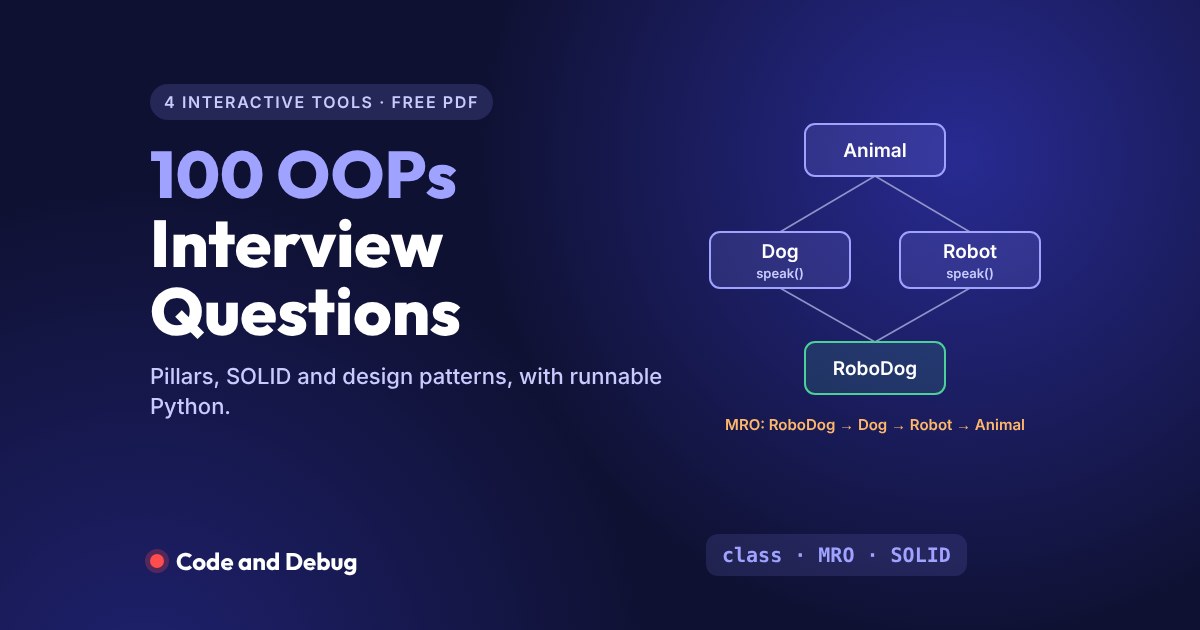
OOPs (object-oriented programming) is asked in almost every software interview in India, from TCS, Infosys and Accenture campus drives to backend and system design rounds at product companies. Freshers get the four pillars and “what is polymorphism?”. Experienced developers get SOLID, design patterns and “design a parking lot”.
This page has the 100 OOPs interview questions asked most often, with clear answers, grouped for freshers, intermediate and experienced candidates. Every example is in Python and was run, so the output you see is real. Where Java or C++ behave differently, which interviewers love to ask about, there is a short note. Four interactive tools let you build classes and objects, trace the method resolution order, test yourself on the four pillars, and refactor a messy class with SOLID. Prefer to study offline? Download all 100 questions as a free PDF.
What you will find on this page
- 100 questions with answers in three levels: 40 for freshers, 35 intermediate, 25 for experienced candidates.
- Four interactive tools: a class and object builder, an inheritance and MRO explorer, a “spot the OOP principle” game, and a SOLID refactoring walkthrough.
- 70 Python examples with real output, plus Java and C++ notes where they differ.
- Practice tools: filters, search, a practice mode that hides answers, and progress tracking.
- A free 55-page PDF and a 10-question quiz at the end.
Helpful to know first (each opens our own guide):
Study these 100 questions your way
Filter the OOPs interview questions by level or topic, search, or hide the answers to test yourself. Your progress is saved in this browser.
No questions match these filters. Try another topic or clear the search.
How to prepare for an OOPs interview
- Explain each pillar with your own example. Definitions are not enough; interviewers ask “give me a real example”. A bank account (encapsulation), payment methods (polymorphism) and employee types (inheritance) cover most of them.
- Know the classic comparisons: overloading vs overriding, abstract class vs interface, composition vs inheritance, class vs instance attributes.
- Be ready for language differences. If you code in Python, expect “does Python support overloading?” and “how does Python handle private members?”. If the role uses Java, revise interfaces,
finalandstatic. - For experienced roles, practise design. SOLID, a handful of design patterns (Singleton, Factory, Strategy, Observer, Builder) and one or two low-level design problems such as a parking lot or LRU cache.
- Write code, not just definitions. Type out the examples on this page and change them. Our Low Level System Design in Python course goes deeper into design problems.
These are the topics that come up most in OOPs interview questions, and where to find them on this page:
| Topic | Asked in | On this page |
|---|---|---|
| Classes, objects and constructors | Almost every fresher interview | 14 questions, starting at Q1 |
| Encapsulation and abstraction | All levels | 10 questions, starting at Q11 |
| Inheritance and the MRO | All levels; deep in Python roles | 8 questions, starting at Q16 |
| Polymorphism, overloading and overriding | All levels | 9 questions, starting at Q19 |
| Composition and relationships | Intermediate and design rounds | 3 questions, starting at Q30 |
| Python-specific OOP | Python developer roles | 25 questions, starting at Q33 |
| SOLID and good design | Experienced, backend roles | 17 questions, starting at Q32 |
| Design patterns and low-level design | Experienced, system design rounds | 14 questions, starting at Q76 |
Learn OOP by doing
Most OOP mistakes come from not having a clear picture of what happens inside: which object owns which data, where Python looks for a method, and why a design is hard to change. These four tools build that picture. Spend ten minutes with them before you read the OOPs interview questions below.
Class and object builder: one blueprint, many objects
Pick a class, create a few objects with different values, and call their methods. Watch each object keep its own data, see what happens when a method protects its rules, and change the shared class attribute to see who is affected. The Python code updates as you go.
Class and object builder
Create an object of
Class attribute (shared)
Objects created: 0 ·
Inheritance and MRO explorer: where does Python find a method?
Choose a class hierarchy, then pick a method. The explorer walks the method resolution order (MRO) one class at a time and stops at the first class that defines the method. Try the diamond where B does not override, and the impossible hierarchy that Python refuses to create.
MRO explorer
Arrows point from child to parent. Orange numbers show the order of parents in the class statement. A green dot means the class defines the chosen method.
Spot the OOP principle
Eight short snippets of the kind interviewers show on a screen. For each one, pick the principle it demonstrates best, then read why.
Encapsulation, abstraction, inheritance or polymorphism?
8 snippets. Takes about two minutes.
SOLID refactoring: fix one messy class, one principle at a time
Here is an OrderManager class of the kind found in many real projects: it validates orders, takes payments, saves to MySQL and emails invoices, all in one place. At each step, spot the problem, then see the refactored code. By the end you will have applied all five SOLID principles.
SOLID refactoring walkthrough
OOPs interview questions for freshers
These 40 basic OOPs interview questions cover what campus placements and first job interviews ask: classes and objects, constructors, the four pillars, access modifiers, overloading and overriding, abstract classes and interfaces, and the most common Python OOP traps.
1. What is object-oriented programming (OOP)?
Object-oriented programming is a way of writing programs by modelling them as a set of objects. Each object bundles some data (attributes) together with the behaviour that works on that data (methods). A banking app might have Account, Customer and Transaction objects, each responsible for its own data.
The goal is to make large programs easier to understand, reuse and change. Objects hide their internal details, share behaviour through inheritance, and can be swapped for one another through polymorphism. Python, Java, C++, C# and Kotlin all support OOP.
2. What is the difference between procedural programming and OOP?
| Point | Procedural | Object-oriented |
|---|---|---|
| Program is built from | Functions that act on data | Objects that own data and behaviour |
| Data | Often global or passed around freely | Kept inside objects and accessed through methods |
| Focus | Steps to perform | Things in the problem and how they interact |
| Reuse | By calling functions | Through inheritance and composition |
| Security of data | Weak; any function can change it | Stronger through encapsulation |
| Best for | Small scripts, simple tasks | Large applications that change over time |
| Examples | C, early BASIC | Java, C++, Python, C# |
Python supports both styles, and real projects often mix them: plain functions for small utilities, classes for the main entities.
3. What are the four pillars of OOP?
- Encapsulation: keep data and the methods that change it together inside a class, and control access to the data.
- Abstraction: show only what an object does and hide how it does it. You call
car.start()without knowing how the engine works. - Inheritance: a new class reuses and extends an existing class. A SavingsAccount is an Account.
- Polymorphism: the same call behaves differently depending on the object.
shape.area()works for a circle and a square, each with its own formula.
The “spot the OOP principle” game on this page has short snippets for you to classify.
4. What are a class and an object?
A class is a blueprint that defines what data and behaviour its objects will have. An object (or instance) is a real thing created from that blueprint, with its own values.
The class Student says every student has a name and marks. Asha and Rohan are two objects of that class, each with their own name and marks.
Official reference: Python tutorial: Classes
class Student:
    def __init__(self, name, marks):
        self.name = name
        self.marks = marks

    def result(self):
        return "Pass" if self.marks >= 40 else "Fail"

asha = Student("Asha", 82)
rohan = Student("Rohan", 35)

print(asha.name, asha.result())
print(rohan.name, rohan.result())
print(type(asha).__name__, isinstance(asha, Student))Output:
Asha Pass
Rohan Fail
Student True5. Does a class take memory? Does an object?
In languages like Java and C++, a class definition by itself does not allocate memory for data. Memory for fields is allocated when an object is created (with new in Java, or on the stack or heap in C++). The class’s code and metadata are loaded once and shared by all objects.
In Python, a class is itself an object (of type type), so it does take some memory: it holds its methods and class attributes in a dictionary. Each instance then takes extra memory for its own attributes. The usual interview answer is still: the class is the blueprint, and each object gets its own memory for its data.
6. What is the difference between instance attributes and class attributes?
- Instance attributes belong to one object and are usually set in
__init__withself.x = .... Each object has its own copy. - Class attributes are defined in the class body and shared by all objects of that class. They suit constants and counters.
Reading obj.x first looks in the object, then in the class. Assigning obj.x = ... always creates or changes the instance attribute, and hides the class attribute for that object only. Java calls class attributes static fields.
class Employee:
    company = "Code and Debug"      # class attribute: shared
    count = 0

    def __init__(self, name):
        self.name = name            # instance attribute: per object
        Employee.count += 1

a = Employee("Asha")
b = Employee("Rohan")
print(a.company, b.company, Employee.count)

a.company = "Other Co"              # creates an instance attribute on a only
print(a.company, b.company, Employee.company)Output:
Code and Debug Code and Debug 2
Other Co Code and Debug Code and Debug7. What is self in Python?
self is the first parameter of every instance method. It refers to the object the method was called on, so the method can read and change that object’s attributes.
When you write acc.deposit(500), Python actually calls Account.deposit(acc, 500). The name self is only a convention, but you should always use it.
Java and C++ note: the equivalent is this, which is passed automatically and does not appear in the parameter list.
class Account:
    def __init__(self, balance):
        self.balance = balance

    def deposit(self, amount):
        self.balance += amount
        return self.balance

acc = Account(1000)
print(acc.deposit(500))
print(Account.deposit(acc, 500)) # the same call, written outOutput:
1500
20008. What is a constructor? What does __init__ do?
A constructor is a special method that runs automatically when an object is created. It sets up the object’s starting state.
In Python, __init__ is the initialiser: it receives the new, empty object as self and sets its attributes. (Strictly, __new__ creates the object and __init__ initialises it; see the intermediate section.) __init__ must return None.
Java and C++ note: a constructor has the same name as the class and no return type, and it is called with new ClassName(...) in Java.
class Course:
    def __init__(self, title, price=0):
        self.title = title
        self.price = price
        print(f"Created course: {title}")

c1 = Course("Python Full Course")
c2 = Course("Master DSA", 4999)
print(c1.price, c2.price)Output:
Created course: Python Full Course
Created course: Master DSA
0 49999. What are the types of constructors?
- Default constructor: takes no arguments. If you write no constructor, Java and C++ give you one automatically.
- Parameterised constructor: takes arguments to set the initial values.
- Copy constructor (C++): creates a new object as a copy of an existing one,
Point(const Point& other).
Python note: a class has only one __init__. You get the effect of several constructors with default arguments, or with class methods as alternative constructors, such as datetime.fromtimestamp(). Copies are made with the copy module.
class Point:
    def __init__(self, x=0, y=0):          # default and parameterised in one
        self.x, self.y = x, y

    @classmethod
    def from_string(cls, text):            # alternative constructor
        x, y = map(int, text.split(","))
        return cls(x, y)

    def __repr__(self):
        return f"Point({self.x}, {self.y})"

print(Point(), Point(3, 4), Point.from_string("7,2"))Output:
Point(0, 0) Point(3, 4) Point(7, 2)10. What is a destructor? Does Python have one?
A destructor runs when an object is destroyed, to release resources such as files or network connections.
- C++:
~ClassName()runs at a predictable time: when the object goes out of scope or is deleted. - Java: has no destructor. Objects are cleaned up by the garbage collector at an unpredictable time, so resources are closed with
try-with-resources. - Python:
__del__is called when the object’s reference count drops to zero. In CPython that is usually immediate, but it is not guaranteed in every situation (for example reference cycles, or interpreter shutdown).
So in Python, do not rely on __del__ for important cleanup. Use a context manager (with) instead.
class TempFile:
    def __init__(self, name):
        self.name = name
        print("open", name)
    def __del__(self):
        print("cleanup", self.name)

f = TempFile("report.txt")
del f                      # last reference removed
print("after del")Output:
open report.txt
cleanup report.txt
after del11. What is encapsulation? Give an example.
Encapsulation means bundling data with the methods that work on it, and controlling how that data can be changed from outside. Other code interacts with the object through its methods instead of editing its internals directly.
In a bank account, the balance should never go negative. If any code could write acc.balance = -5000, that rule would break. With encapsulation, the balance can only change through deposit and withdraw, which check the rule.
class BankAccount:
    def __init__(self, owner, balance=0):
        self.owner = owner
        self.__balance = balance            # private by name mangling

    def deposit(self, amount):
        if amount <= 0:
            raise ValueError("Deposit must be positive")
        self.__balance += amount

    def withdraw(self, amount):
        if amount > self.__balance:
            raise ValueError("Insufficient balance")
        self.__balance -= amount

    def get_balance(self):
        return self.__balance

acc = BankAccount("Asha", 1000)
acc.deposit(500)
try:
    acc.withdraw(5000)
except ValueError as e:
    print("Error:", e)
print(acc.get_balance())Output:
Error: Insufficient balance
150012. What are access modifiers? How does Python handle public, protected and private?
| Modifier | Java and C++ | Python convention |
|---|---|---|
| Public | Accessible everywhere | name |
| Protected | Class and subclasses (Java: also the same package) | _name: a hint, “internal, do not use from outside” |
| Private | Only inside the class; enforced by the compiler | __name: renamed to _ClassName__name (name mangling) |
| Default (package-private) | Java only: same package | No equivalent |
Python has no enforced access control. A single underscore is a convention, and a double underscore only makes accidental access and clashes in subclasses less likely. The Python saying is “we are all consenting adults here”.
Official reference: Java tutorial: Controlling Access to Members of a Class
class User:
    def __init__(self):
        self.name = "Asha"        # public
        self._role = "admin"      # protected by convention
        self.__password = "s3cr3t" # private: name-mangled

u = User()
print(u.name, u._role)
try:
    print(u.__password)
except AttributeError as e:
    print("AttributeError:", e)
print(u._User__password) # still reachable, but you should not do thisOutput:
Asha admin
AttributeError: 'User' object has no attribute '__password'
s3cr3t13. What are getters and setters? How does @property work in Python?
Getters and setters are methods that read and change an attribute, so the class can validate values or compute them. Java code is full of getAge() and setAge().
In Python you start with a plain attribute. If you later need validation, you turn it into a property: code still writes p.age = 30, but your setter runs. So you never have to write getters and setters in advance.
class Person:
    def __init__(self, name, age):
        self.name = name
        self.age = age               # goes through the setter below

    @property
    def age(self):
        return self._age

    @age.setter
    def age(self, value):
        if not 0 <= value <= 150:
            raise ValueError("Age must be between 0 and 150")
        self._age = value

p = Person("Rohan", 25)
p.age = 26
print(p.age)
try:
    p.age = -5
except ValueError as e:
print("Error:", e)Output:
26
Error: Age must be between 0 and 15014. What is abstraction?
Abstraction means exposing only the essential features of an object and hiding the complex details of how they work. Users of the object depend on what it does, not how.
When you call payment.pay(500), you do not need to know whether it goes through UPI, a card network or a wallet. The details are hidden behind a simple interface, and they can change without breaking the code that calls it.
In code, abstraction is achieved with abstract classes and interfaces (which define what must be done), and with well-chosen public methods that hide internal steps.
15. What is the difference between abstraction and encapsulation?
| Point | Abstraction | Encapsulation |
|---|---|---|
| Purpose | Hide complexity; show only what matters | Protect data; control how it is accessed |
| Focus | Design: what an object does | Implementation: how data is kept safe |
| Achieved with | Abstract classes, interfaces, simple public methods | Private attributes, getters, setters, properties |
| Question it answers | “What should the user see?” | “Who can change this data?” |
| Example | A Payment interface with pay() | A private __balance changed only by deposit() |
They work together: encapsulation is one of the tools that makes abstraction possible.
16. What is inheritance?
Inheritance lets a new class (the child, subclass or derived class) reuse the attributes and methods of an existing class (the parent, superclass or base class), then add or change behaviour. It models an “is-a” relationship: a Dog is an Animal.
Benefits: code reuse, a clear hierarchy, and the ability to treat different subclasses through the parent type (polymorphism).
class Animal:
    def __init__(self, name):
        self.name = name
    def describe(self):
        return f"{self.name} is an animal"
    def sound(self):
        return "..."

class Dog(Animal):                  # Dog inherits from Animal
    def sound(self):                # and overrides one method
        return "Woof"

d = Dog("Tommy")
print(d.describe())                 # inherited
print(d.sound())                    # overridden
print(isinstance(d, Animal), issubclass(Dog, Animal))Output:
Tommy is an animal
Woof
True True17. What are the types of inheritance?
- Single: one child, one parent.
Dog(Animal). - Multilevel: a chain.
Puppy(Dog),Dog(Animal). - Hierarchical: many children of one parent.
Dog(Animal),Cat(Animal). - Multiple: one child with several parents.
FlyingCar(Car, Aircraft). - Hybrid: a mix of the above, which can create the diamond problem.
Java note: a class can extend only one class, so Java has no multiple inheritance of classes. It gets a similar effect by implementing several interfaces. C++ and Python support multiple inheritance; Python resolves conflicts with the MRO (see the intermediate section and the MRO explorer on this page).
18. What does super() do?
super() gives you access to methods of the parent class (strictly, the next class in the MRO). It is mostly used to call the parent’s __init__ so the parent part of the object is set up, and to extend a parent method instead of replacing it completely.
Java note: super(...) calls the parent constructor and must be the first statement in a constructor; super.method() calls the parent’s version of a method.
Official reference: Python docs: super()
class Account:
    def __init__(self, owner, balance):
        self.owner = owner
        self.balance = balance
    def summary(self):
        return f"{self.owner}: Rs {self.balance}"

class SavingsAccount(Account):
    def __init__(self, owner, balance, rate):
        super().__init__(owner, balance)   # let the parent set its part
        self.rate = rate
    def summary(self):
        return super().summary() + f" at {self.rate}% interest"

print(SavingsAccount("Asha", 5000, 7).summary())Output:
Asha: Rs 5000 at 7% interest19. What is method overriding?
Method overriding is when a child class provides its own version of a method that already exists in the parent class, with the same name and parameters. When the method is called on a child object, the child’s version runs.
It is how runtime polymorphism works: code written against the parent type automatically uses the right behaviour for each child.
Java note: mark overriding methods with @Override so the compiler checks the signature. A final method cannot be overridden, and static methods are hidden, not overridden.
class Notification:
    def send(self, msg):
        return f"Generic: {msg}"

class Email(Notification):
    def send(self, msg):
        return f"Email: {msg}"

class SMS(Notification):
    def send(self, msg):
        return f"SMS: {msg[:20]}"

for n in [Notification(), Email(), SMS()]:
print(n.send("Your class starts at 7 pm tonight"))Output:
Generic: Your class starts at 7 pm tonight
Email: Your class starts at 7 pm tonight
SMS: Your class starts at20. What is polymorphism? What are compile-time and runtime polymorphism?
Polymorphism (“many forms”) means one interface can work with objects of different types, and each type responds in its own way.
| Point | Compile-time (static) | Runtime (dynamic) |
|---|---|---|
| Achieved by | Method overloading, operator overloading | Method overriding |
| Decided | By the compiler, from argument types | At runtime, from the object’s actual type |
| Also called | Early binding | Late binding, dynamic dispatch |
| Example | add(int, int) vs add(double, double) in Java | shape.area() on a Circle or a Square |
Python note: Python decides everything at runtime, so all its polymorphism is runtime polymorphism, including duck typing.
21. What is method overloading? Does Python support it?
Method overloading means defining several methods with the same name but different parameters (number or types) in one class. Java and C++ support it, and the compiler picks the right version.
Python does not: if you define two methods with the same name, the second one replaces the first. You get the same effect with default arguments, *args, or functools.singledispatchmethod to choose by type.
Official reference: Java tutorial: Defining Methods (overloading)
class Calculator:
    def add(self, a, b):
        return a + b
    def add(self, a, b, c):          # replaces the first add
        return a + b + c

try:
    Calculator().add(1, 2)
except TypeError as e:
    print("TypeError:", e)

class BetterCalculator:
    def add(self, *nums):             # one method, any number of arguments
        return sum(nums)

print(BetterCalculator().add(1, 2), BetterCalculator().add(1, 2, 3))Output:
TypeError: Calculator.add() missing 1 required positional argument: 'c'
3 622. What is the difference between method overloading and method overriding?
| Point | Overloading | Overriding |
|---|---|---|
| Where | Same class | Parent and child classes |
| Method signature | Same name, different parameters | Same name and same parameters |
| Type of polymorphism | Compile-time | Runtime |
| Inheritance needed | No | Yes |
| Return type (Java) | Can differ | Same, or a subtype (covariant return) |
| Python support | Not directly | Yes |
23. What is operator overloading?
Operator overloading lets your own classes work with operators like +, ==, < or len(). In Python you do it by defining special (“dunder”) methods: __add__ for +, __eq__ for ==, __lt__ for <, __len__ for len().
Java note: Java does not allow operator overloading (apart from the built-in + for strings). C++ does, with functions such as operator+.
class Money:
    def __init__(self, rupees):
        self.rupees = rupees
    def __add__(self, other):
        return Money(self.rupees + other.rupees)
    def __lt__(self, other):
        return self.rupees < other.rupees
    def __repr__(self):
        return f"Rs {self.rupees}"

fees, books = Money(4999), Money(800)
print(fees + books)
print(books < fees)
print(sorted([fees, books]))Output:
Rs 5799
True
[Rs 800, Rs 4999]24. What is duck typing?
“If it walks like a duck and quacks like a duck, it is a duck.” In duck typing, Python does not check an object’s class; it only checks that the object has the method you call. Any object with the right methods works, even with no shared parent class.
This is why len() works on lists, strings, dicts and your own classes that define __len__, and why any object with read() can be used where a file is expected.
Java note: Java needs an explicit shared type, such as an interface, for this kind of polymorphism. Python’s typing.Protocol adds type-checker support for duck typing.
class Dog:
    def speak(self): return "Woof"

class Robot:
    def speak(self): return "Beep"

def make_it_speak(thing):           # no type check at all
    return thing.speak()

print(make_it_speak(Dog()), make_it_speak(Robot()))Output:
Woof Beep25. What is an abstract class? How do you create one in Python?
An abstract class is a class that cannot be instantiated and exists to be inherited from. It can contain abstract methods (declared but not implemented) that every concrete subclass must implement, as well as normal methods with shared code.
In Python, inherit from ABC and mark methods with @abstractmethod. Python then refuses to create an object of any class that has not implemented every abstract method.
Java note: use the abstract keyword on the class and the methods.
from abc import ABC, abstractmethod

class Shape(ABC):
    @abstractmethod
    def area(self): ...

    def describe(self):                       # shared, concrete method
        return f"{type(self).__name__} with area {self.area():.2f}"

class Circle(Shape):
    def __init__(self, r): self.r = r
    def area(self): return 3.14159 * self.r ** 2

class Square(Shape):
    def __init__(self, s): self.s = s
    def area(self): return self.s ** 2

for s in [Circle(2), Square(3)]:
    print(s.describe())

try:
    Shape()
except TypeError as e:
print("TypeError:", e)Output:
Circle with area 12.57
Square with area 9.00
TypeError: Can't instantiate abstract class Shape without an implementation for abstract method 'area'26. What is an interface?
An interface is a contract: a list of methods a class promises to provide, with no shared state. Code can depend on the interface, and any class that implements it can be plugged in.
- Java: declared with
interface, implemented withimplements. A class can implement many interfaces. Since Java 8, interfaces can havedefaultandstaticmethods. - C++: no keyword; a class with only pure virtual functions acts as an interface.
- Python: no keyword; use an abstract base class with only abstract methods, or a
typing.Protocolfor structural (duck-typed) interfaces.
Official reference: Java tutorial: Defining an Interface
27. What is the difference between an abstract class and an interface?
| Point | Abstract class | Interface |
|---|---|---|
| Methods | Abstract and concrete | Abstract (Java 8+: also default and static) |
| State (fields) | Can have instance variables | Only constants (Java) |
| Constructors | Yes | No |
| Inheritance | A class extends only one (Java) | A class can implement many |
| Access modifiers | Any | Methods public by default |
| Relationship | “Is-a” with shared code | “Can-do” capability |
| Use when | Related classes share code and state | Unrelated classes share a capability, such as Comparable or Serializable |
Official reference: Python docs: abc, Abstract Base Classes
28. What is the difference between instance methods, class methods and static methods?
| Type | First parameter | Can access | Typical use |
|---|---|---|---|
| Instance method | self (the object) | Object and class data | Most behaviour |
Class method (@classmethod) | cls (the class) | Class data, not a specific object | Alternative constructors, class-wide counters |
Static method (@staticmethod) | None | Neither, unless passed in | Helper functions that belong with the class |
Java note: Java has instance methods and static methods; there is no direct equivalent of a class method that receives the class.
class Pizza:
    def __init__(self, toppings):
        self.toppings = toppings

    def describe(self):                         # instance method
        return "Pizza with " + ", ".join(self.toppings)

    @classmethod
    def margherita(cls):                        # alternative constructor
        return cls(["tomato", "mozzarella"])

    @staticmethod
    def is_valid_size(inches):                  # plain helper
        return inches in (8, 10, 12)

print(Pizza.margherita().describe())
print(Pizza.is_valid_size(10), Pizza.is_valid_size(9))Output:
Pizza with tomato, mozzarella
True False29. What goes wrong with a mutable class attribute?
A class attribute is shared by every object. If it is mutable, such as a list or dict, changing it through one object changes it for all of them. This is one of the most common Python OOP bugs, and a favourite trick question.
The fix is to create mutable data per object in __init__.
class Batch:
    students = []                    # shared by ALL batches: a bug
    def add(self, name):
        self.students.append(name)

morning, evening = Batch(), Batch()
morning.add("Asha")
print(evening.students)              # evening sees Asha too

class FixedBatch:
    def __init__(self):
        self.students = []           # one list per object
    def add(self, name):
        self.students.append(name)

m, e = FixedBatch(), FixedBatch()
m.add("Asha")
print(m.students, e.students)Output:
['Asha']
['Asha'] []30. What is the difference between composition and inheritance?
- Inheritance models “is-a”: a Car is a Vehicle. The child gets the parent’s code.
- Composition models “has-a”: a Car has an Engine. One object holds another and delegates work to it.
| Point | Inheritance | Composition |
|---|---|---|
| Coupling | Tight: child depends on parent internals | Loose: depends only on the part’s public methods |
| Flexibility | Fixed when the class is written | Parts can be swapped, even at runtime |
| Risk | Deep hierarchies that are hard to change | More small classes to wire together |
The common advice is “favour composition over inheritance”: use inheritance only for a true “is-a” relationship where the child can stand in for the parent everywhere.
class Engine:
    def start(self): return "engine started"

class ElectricMotor:
    def start(self): return "motor humming"

class Car:
    def __init__(self, engine):          # Car HAS an engine
        self.engine = engine
    def drive(self):
        return f"Car: {self.engine.start()}, driving"

print(Car(Engine()).drive())
print(Car(ElectricMotor()).drive()) # swap the part, same Car classOutput:
Car: engine started, driving
Car: motor humming, driving31. What are association, aggregation and composition?
All three describe how objects relate. They differ in ownership and lifetime:
| Relationship | Meaning | Lifetime | Example |
|---|---|---|---|
| Association | Objects use or know each other | Independent | A Teacher and a Student |
| Aggregation | A whole has parts, but the parts can exist alone (“weak has-a”) | Parts outlive the whole | A Department has Professors; closing the department does not delete them |
| Composition | A whole owns its parts (“strong has-a”) | Parts die with the whole | A House has Rooms; demolish the house and the rooms are gone |
In UML, aggregation is drawn with a hollow diamond and composition with a filled diamond on the “whole” side.
32. What are coupling and cohesion?
- Cohesion is how closely the responsibilities inside one class belong together. High cohesion is good: an
InvoicePrinterthat only prints invoices. - Coupling is how much one class depends on the details of another. Low coupling is good: changing one class should not force changes in many others.
The goal is high cohesion, low coupling. You get there by giving each class one clear job, depending on interfaces instead of concrete classes, and passing dependencies in rather than creating them inside. The SOLID refactoring tool on this page shows this step by step.
33. What is the difference between is and ==?
==checks equality: do the two objects have the same value? It calls__eq__, which you can define.ischecks identity: are they the very same object in memory?
Use is only for singletons such as None (if x is None). For values, use ==. By default, a class without __eq__ compares by identity, so two objects with the same data are not equal until you define it.
Java note: the same trap exists: == compares references and .equals() compares values, which is why "a" == new String("a") is false.
class Point:
    def __init__(self, x, y): self.x, self.y = x, y

class Point2:
    def __init__(self, x, y): self.x, self.y = x, y
    def __eq__(self, other): return (self.x, self.y) == (other.x, other.y)

print(Point(1, 2) == Point(1, 2))     # no __eq__: compares identity
print(Point2(1, 2) == Point2(1, 2))   # value equality
a = Point2(1, 2); b = a
print(a is b, Point2(1, 2) is Point2(1, 2))Output:
False
True
True False34. What is the difference between __str__ and __repr__?
__str__returns a readable string for users. It is used byprint()andstr().__repr__returns an unambiguous string for developers, ideally one that looks like code to recreate the object. It is used in the console, in lists, and as a fallback when__str__is missing.
If you write only one, write __repr__. Java note: the equivalent is overriding toString().
class Course:
    def __init__(self, title, price):
        self.title, self.price = title, price
    def __str__(self):
        return f"{self.title} (Rs {self.price})"
    def __repr__(self):
        return f"Course({self.title!r}, {self.price})"

c = Course("Master DSA", 4999)
print(c)          # __str__
print(repr(c))    # __repr__
print([c]) # lists use __repr__Output:
Master DSA (Rs 4999)
Course('Master DSA', 4999)
[Course('Master DSA', 4999)]35. What do isinstance() and issubclass() do?
isinstance(obj, Cls)is true ifobjis an instance ofClsor any of its subclasses. It accepts a tuple of classes.issubclass(A, B)is true if classAinherits fromB(a class counts as a subclass of itself).
Prefer isinstance over type(obj) == Cls, because the exact type check breaks for subclasses. Even better, avoid type checks where duck typing or polymorphism can do the job.
class Animal: pass
class Dog(Animal): pass

d = Dog()
print(isinstance(d, Dog), isinstance(d, Animal), isinstance(d, (int, str)))
print(type(d) == Animal)              # False: exact type check
print(issubclass(Dog, Animal), issubclass(Animal, Dog), issubclass(Dog, object))Output:
True True False
False
True False True36. What are the advantages and disadvantages of OOP?
Advantages:
- Models real-world problems naturally.
- Code reuse through inheritance and composition.
- Encapsulation protects data and limits the effect of changes.
- Polymorphism lets you add new types without changing existing code.
- Easier to split work across a team, one class or module at a time.
Disadvantages:
- More code and design effort for small programs.
- Deep inheritance hierarchies become rigid and hard to understand.
- Some overhead from objects and method calls.
- Shared mutable state inside objects makes concurrency harder; functional styles avoid this.
37. Is Python a fully object-oriented language?
In Python, everything is an object: numbers, strings, functions, classes and modules all have a type and can have attributes and methods. Even 5 is an instance of the class int.
But Python is multi-paradigm: it does not force you to write classes, and it supports procedural and functional programming too. It also has no enforced private members. So the usual answer is: Python is object-based to its core and fully supports OOP, but it is not “purely” object-oriented in the strict sense some people apply to languages like Smalltalk.
Java note: Java is often called “not purely OOP” because of its primitive types (int, double) and static methods.
print(type(5), type("hi"), type(len), type(int))
print((5).bit_length(), "hi".upper())
def greet(): return "hello"
greet.author = "Anirudh"           # functions are objects with attributes
print(greet.author)Output:
<class 'int'> <class 'str'> <class 'builtin_function_or_method'> <class 'type'>
3 HI
Anirudh38. What is dynamic binding (late binding)?
Binding links a method call to the code that will run. With static (early) binding, the compiler decides from the declared type. With dynamic (late) binding, the decision is made at runtime from the object’s actual type.
Dynamic binding is what makes method overriding useful: a variable of type Shape can hold a Circle, and shape.area() calls the circle’s version.
- Java: instance methods use dynamic binding;
static,privateandfinalmethods are bound statically. - C++: only methods marked
virtualuse dynamic binding. - Python: every method call is resolved at runtime.
39. Can you create an object of an abstract class? Can an abstract class have a constructor?
No, you cannot instantiate an abstract class directly. Java gives a compile error, C++ refuses a class with pure virtual functions, and Python raises TypeError when a class still has unimplemented abstract methods.
Yes, an abstract class can have a constructor. It runs when a concrete subclass is created, through super().__init__(), to set up the shared state.
from abc import ABC, abstractmethod

class Employee(ABC):
    def __init__(self, name):
        self.name = name
        print("Employee constructor ran for", name)
    @abstractmethod
    def salary(self): ...

class Intern(Employee):
    def salary(self): return 15000

try:
    Employee("Asha")
except TypeError as e:
    print("TypeError:", e)
i = Intern("Rohan")
print(i.name, i.salary())Output:
TypeError: Can't instantiate abstract class Employee without an implementation for abstract method 'salary'
Employee constructor ran for Rohan
Rohan 1500040. Design a simple class for a real-world object, such as a library book.
Interviewers ask this to check that you can choose sensible attributes and methods and protect the object’s rules. Talk through it: identify the data, the actions, the rules, and how other code will use it.
For a library book: data is title, author, ISBN and whether it is issued; actions are issue and return; rules are “cannot issue an issued book” and “cannot return a book that is not issued”.
class Book:
    def __init__(self, title, author, isbn):
        self.title = title
        self.author = author
        self.isbn = isbn
        self._issued_to = None

    @property
    def is_available(self):
        return self._issued_to is None

    def issue(self, member):
        if not self.is_available:
            raise ValueError(f"'{self.title}' is already issued to {self._issued_to}")
        self._issued_to = member

    def give_back(self):
        if self.is_available:
            raise ValueError(f"'{self.title}' was not issued")
        self._issued_to = None

    def __repr__(self):
        status = "available" if self.is_available else f"issued to {self._issued_to}"
        return f"<Book {self.title!r}, {status}>"

b = Book("Clean Code", "Robert C. Martin", "9780132350884")
b.issue("Asha")
print(b)
try:
    b.issue("Rohan")
except ValueError as e:
    print("Error:", e)
b.give_back()
print(b)Output:
<Book 'Clean Code', issued to Asha>
Error: 'Clean Code' is already issued to Asha
<Book 'Clean Code', available>
Intermediate OOPs interview questions
These 35 intermediate OOPs interview questions go deeper: multiple inheritance and the MRO, magic methods, descriptors, dataclasses, protocols, the five SOLID principles with code, composition over inheritance, and how Python, Java and C++ differ on virtual functions, final and immutability.
41. What is the diamond problem? How does Python solve it with the MRO?
The diamond problem appears with multiple inheritance: classes B and C both inherit from A, and D inherits from both B and C. If B and C both override a method from A, which version does D get? And is A’s part of the object set up once or twice?
Python solves it with the Method Resolution Order (MRO), computed by the C3 linearisation algorithm. It produces one fixed order in which classes are searched: the child first, then parents left to right, and a shared base only after all of its children. You can read it from ClassName.__mro__ or ClassName.mro(). The MRO explorer on this page lets you try different hierarchies.
Java note: Java avoids the problem for classes by banning multiple class inheritance. For interface default methods with the same signature, the class must override and choose. C++ needs virtual inheritance so that A’s part is shared.
Official reference: The Python 2.3 Method Resolution Order
class A:
    def hello(self): return "A"
class B(A):
    def hello(self): return "B"
class C(A):
    def hello(self): return "C"
class D(B, C):
    pass

print(D().hello())
print([cls.__name__ for cls in D.__mro__])Output:
B
['D', 'B', 'C', 'A', 'object']42. How does super() work with multiple inheritance?
super() does not simply mean “my parent”. It means “the next class after me in the MRO of the object’s actual class”. When every class in a hierarchy calls super(), each method in the chain runs exactly once, in MRO order. This is called cooperative multiple inheritance.
That is why, in the example, B’s super() call goes to C, not to A, even though B only inherits from A. To make it work, every class should call super() and accept extra keyword arguments with **kwargs when constructors differ.
class A:
    def setup(self):
        print("A.setup")
class B(A):
    def setup(self):
        print("B.setup"); super().setup()
class C(A):
    def setup(self):
        print("C.setup"); super().setup()
class D(B, C):
    def setup(self):
        print("D.setup"); super().setup()

D().setup() # A runs once, at the endOutput:
D.setup
B.setup
C.setup
A.setup43. What is a mixin?
A mixin is a small class that provides one specific piece of behaviour to be “mixed into” other classes through multiple inheritance. It is not meant to be used on its own and usually has no __init__ of its own.
Examples: a JsonMixin that adds to_json(), a TimestampMixin that adds created and updated times, or Django’s LoginRequiredMixin for views. Mixins let you share behaviour across unrelated classes without building a deep hierarchy. By convention they are listed before the main base class.
import json

class JsonMixin:
    def to_json(self):
        return json.dumps(self.__dict__)

class ReprMixin:
    def __repr__(self):
        fields = ", ".join(f"{k}={v!r}" for k, v in self.__dict__.items())
        return f"{type(self).__name__}({fields})"

class Student(JsonMixin, ReprMixin):
    def __init__(self, name, batch):
        self.name, self.batch = name, batch

s = Student("Asha", "DSA-Nov")
print(s)
print(s.to_json())Output:
Student(name='Asha', batch='DSA-Nov')
{"name": "Asha", "batch": "DSA-Nov"}44. What are magic (dunder) methods? Name the important ones.
Magic methods (double underscore, “dunder”) let your objects work with Python’s built-in syntax and functions. Python calls them for you.
| You write | Python calls |
|---|---|
Cls(...) | __new__, then __init__ |
str(x), repr(x) | __str__, __repr__ |
len(x), x[i], v in x | __len__, __getitem__, __contains__ |
for v in x | __iter__, __next__ |
x == y, x < y, hash(x) | __eq__, __lt__, __hash__ |
x + y, x * y | __add__, __mul__ |
with x: | __enter__, __exit__ |
x() | __call__ |
class Playlist:
    def __init__(self, songs): self.songs = list(songs)
    def __len__(self): return len(self.songs)
    def __getitem__(self, i): return self.songs[i]
    def __contains__(self, song): return song in self.songs

p = Playlist(["Intro", "Arrays", "Strings"])
print(len(p), p[1], "Arrays" in p)
print([s.upper() for s in p]) # __getitem__ alone makes it iterableOutput:
3 Arrays True
['INTRO', 'ARRAYS', 'STRINGS']45. Why must __eq__ and __hash__ be consistent?
Sets and dictionaries find objects by their hash, then confirm with equality. The rule is: if a == b, then hash(a) == hash(b). If you break it, equal objects end up as duplicates in a set or cannot be found as dict keys.
Python helps: when you define __eq__ without __hash__, the class becomes unhashable. If the object is immutable, define __hash__ from the same fields used in __eq__. Never hash mutable fields that can change while the object is inside a set.
Java note: the same contract applies to equals() and hashCode().
class P1:
    def __init__(self, x): self.x = x
    def __eq__(self, o): return self.x == o.x

try:
    {P1(1)}
except TypeError as e:
    print("TypeError:", e)

class P2:
    def __init__(self, x): self.x = x
    def __eq__(self, o): return self.x == o.x
    def __hash__(self): return hash(self.x)

print(len({P2(1), P2(1), P2(2)}))Output:
TypeError: unhashable type: 'P1'
246. What is the difference between __new__ and __init__?
__new__(cls, ...)is a static method that creates and returns the new object. It runs first.__init__(self, ...)initialises the object that__new__returned. It must returnNone.
You rarely override __new__. The main reasons are subclassing immutable types (int, str, tuple), where the value must be set at creation, and controlling instance creation, as in a singleton or an instance cache.
class Celsius(float):
    def __new__(cls, value):
        print("__new__ creates the object")
        return super().__new__(cls, round(value, 1))
    def __init__(self, value):
        print("__init__ sets it up")
        self.unit = "C"

t = Celsius(36.6666)
print(t, t.unit, isinstance(t, float))Output:
__new__ creates the object
__init__ sets it up
36.7 C True47. What is the difference between a shallow copy and a deep copy of an object?
- Assignment (
b = a) copies nothing; both names point to the same object. - Shallow copy (
copy.copy) creates a new outer object, but its attributes still point to the same inner objects. Changing a nested list affects both. - Deep copy (
copy.deepcopy) copies the object and, recursively, everything it contains.
You can customise both with __copy__ and __deepcopy__. Java note: clone() is shallow by default; deep copies need copy constructors or serialisation. C++: the default copy constructor is shallow for pointer members.
import copy

class Batch:
    def __init__(self, name, students):
        self.name, self.students = name, students

orig = Batch("Morning", ["Asha", "Rohan"])
shallow = copy.copy(orig)
deep = copy.deepcopy(orig)

orig.students.append("Meera")
print("shallow:", shallow.students)   # shares the list
print("deep :", deep.students) # has its own listOutput:
shallow: ['Asha', 'Rohan', 'Meera']
deep : ['Asha', 'Rohan']48. What are descriptors?
A descriptor is an object that defines __get__, __set__ or __delete__ and is stored as a class attribute. When you access that attribute on an instance, Python calls the descriptor’s methods instead of reading the value directly.
Descriptors are the machinery behind @property, methods (which is how self gets bound), @classmethod, @staticmethod, and Django model fields. Write your own when the same validation logic is needed on many attributes, so you do not repeat a property for each one.
class Positive:
    def __set_name__(self, owner, name):
        self.name = "_" + name
    def __get__(self, obj, objtype=None):
        return getattr(obj, self.name)
    def __set__(self, obj, value):
        if value <= 0:
            raise ValueError(f"{self.name[1:]} must be positive")
        setattr(obj, self.name, value)

class Product:
    price = Positive()          # one descriptor, reused
    stock = Positive()
    def __init__(self, price, stock):
        self.price, self.stock = price, stock

p = Product(499, 10)
print(p.price, p.stock)
try:
    p.stock = 0
except ValueError as e:
print("Error:", e)Output:
499 10
Error: stock must be positive49. What is __slots__ and when would you use it?
By default, every Python object stores its attributes in a per-instance dictionary, __dict__. Declaring __slots__ tells Python to store a fixed set of attributes in a compact array instead.
- Benefits: much less memory per object and slightly faster attribute access. Useful when you create millions of small objects.
- Trade-off: you cannot add attributes that are not listed, and multiple inheritance with slots needs care.
class PointDict:
    def __init__(self, x, y): self.x, self.y = x, y

class PointSlots:
    __slots__ = ("x", "y")
    def __init__(self, x, y): self.x, self.y = x, y

a, b = PointDict(1, 2), PointSlots(1, 2)
print("has __dict__:", hasattr(a, "__dict__"), hasattr(b, "__dict__"))
try:
    b.z = 3
except AttributeError as e:
print("AttributeError:", e)Output:
has __dict__: True False
AttributeError: 'PointSlots' object has no attribute 'z' and no __dict__ for setting new attributes50. What are dataclasses? When should you use them?
@dataclass (Python 3.7+) writes the boring parts of a class for you from type-annotated fields: __init__, __repr__ and __eq__, and optionally ordering, immutability (frozen=True) and __slots__.
Use them for classes that mainly hold data: DTOs, configuration, API responses, value objects. Use field(default_factory=list) for mutable defaults, which avoids the shared-list bug. For heavy validation, libraries such as Pydantic go further.
Java note: Java 16+ has record for the same purpose.
Official reference: Python docs: dataclasses
from dataclasses import dataclass, field

@dataclass(order=True)
class Course:
    price: int
    title: str
    tags: list = field(default_factory=list)

a = Course(4999, "Master DSA", ["dsa"])
b = Course(1999, "Python Basics")
print(a)
print(a == Course(4999, "Master DSA", ["dsa"]))
print(sorted([a, b])[0].title)Output:
Course(price=4999, title='Master DSA', tags=['dsa'])
True
Python Basics51. How do you make your own class iterable?
An object is iterable if __iter__ returns an iterator. An iterator has __next__, which returns the next value or raises StopIteration when done.
The simplest way is to write __iter__ as a generator with yield: Python builds the iterator for you, and the object can be looped over many times.
class Countdown:
    def __init__(self, start):
        self.start = start
    def __iter__(self):              # a generator: returns a fresh iterator each time
        n = self.start
        while n > 0:
            yield n
            n -= 1

c = Countdown(3)
print(list(c), list(c))
it = iter(c)
print(next(it), next(it))Output:
[3, 2, 1] [3, 2, 1]
3 252. How do you write a class that works with the with statement?
A context manager defines __enter__, which runs at the start of the with block, and __exit__, which always runs at the end, even if an exception is raised. It is the Pythonic way to manage resources: files, locks, database transactions and network connections.
If __exit__ returns True, the exception is suppressed; normally it returns False or None so errors propagate. Java note: the equivalent is try-with-resources with AutoCloseable.
class Transaction:
    def __enter__(self):
        print("BEGIN")
        return self
    def __exit__(self, exc_type, exc, tb):
        print("ROLLBACK" if exc_type else "COMMIT")
        return False                   # do not hide errors

with Transaction():
    print("update balance")

try:
    with Transaction():
        raise ValueError("insufficient balance")
except ValueError as e:
print("Caught:", e)Output:
BEGIN
update balance
COMMIT
BEGIN
ROLLBACK
Caught: insufficient balance53. What is a callable object (__call__)?
If a class defines __call__, its instances can be called like functions: obj(args). This is useful when you need a function that also keeps state or configuration, such as a rate limiter, a counter, a configured validator, or a machine learning model (PyTorch modules are callable for this reason).
class Multiplier:
    def __init__(self, factor):
        self.factor = factor
        self.calls = 0
    def __call__(self, x):
        self.calls += 1
        return x * self.factor

double = Multiplier(2)
print(double(5), double(21), callable(double), double.calls)Output:
10 42 True 254. What is a Protocol (structural typing) in Python?
An abstract base class requires classes to inherit from it (nominal typing). A typing.Protocol describes the methods an object must have, and any class with those methods matches, without inheriting (structural typing). It is duck typing that type checkers such as mypy can verify.
With @runtime_checkable, you can also use the protocol in isinstance checks (which only check that the methods exist).
from typing import Protocol, runtime_checkable

@runtime_checkable
class Payable(Protocol):
    def pay(self, amount: int) -> str: ...

class Upi:                                   # no inheritance
    def pay(self, amount): return f"UPI paid Rs {amount}"

class Card:
    def pay(self, amount): return f"Card paid Rs {amount}"

def checkout(method: Payable, amount: int):
    return method.pay(amount)

print(checkout(Upi(), 499), "|", checkout(Card(), 999))
print(isinstance(Upi(), Payable), isinstance("text", Payable))Output:
UPI paid Rs 499 | Card paid Rs 999
True False55. How do you create custom exceptions? Why use a class hierarchy for them?
Custom exceptions are classes that inherit from Exception (never directly from BaseException). A small hierarchy lets callers catch errors at the right level: one specific error, or every error from your module with the base class.
Exceptions can carry extra data as attributes, which is better than parsing the message text.
class PaymentError(Exception):
    pass

class InsufficientFunds(PaymentError):
    def __init__(self, needed, available):
        super().__init__(f"Need Rs {needed}, have Rs {available}")
        self.shortfall = needed - available

class CardDeclined(PaymentError):
    pass

for err in [InsufficientFunds(5000, 3200), CardDeclined("Bank declined")]:
    try:
        raise err
    except InsufficientFunds as e:
        print("Funds:", e, "| short by", e.shortfall)
    except PaymentError as e:
print("Other payment error:", e)Output:
Funds: Need Rs 5000, have Rs 3200 | short by 1800
Other payment error: Bank declined56. What are the SOLID principles?
SOLID is a set of five design principles, popularised by Robert C. Martin, for classes that are easy to change and test:
- S, Single Responsibility: a class should have one reason to change.
- O, Open/Closed: open for extension, closed for modification. Add behaviour with new code, not by editing working code.
- L, Liskov Substitution: a subclass must be usable anywhere its parent is expected, without surprises.
- I, Interface Segregation: many small, focused interfaces are better than one large one.
- D, Dependency Inversion: depend on abstractions, not concrete classes. High-level code should not create its low-level dependencies.
The SOLID refactoring tool on this page applies each principle to one messy class, step by step.
Official reference: SOLID on Wikipedia
57. Explain the Single Responsibility Principle with an example.
A class should have one reason to change, meaning one job owned by one part of the business. A Report class that calculates figures, formats them as PDF and emails them has three reasons to change: the finance team’s rules, the design team’s layout and the IT team’s email server.
Split it so each class has one job. Each part can then change and be tested on its own.
class SalesReport:                      # only the numbers
    def __init__(self, sales): self.sales = sales
    def total(self): return sum(self.sales)

class TextFormatter:                    # only the presentation
    def format(self, report): return f"Total sales: Rs {report.total():,}"

class ConsoleSender:                    # only the delivery
    def send(self, text): print("Sending ->", text)

report = SalesReport([12000, 8500, 4300])
ConsoleSender().send(TextFormatter().format(report))Output:
Sending -> Total sales: Rs 24,80058. Explain the Open/Closed Principle with an example.
Software should be open for extension but closed for modification. When a new requirement arrives, you should be able to add a new class instead of editing tested code.
The warning sign is a long if/elif on a type: every new payment method or shape means editing the same function. Replace it with polymorphism, so adding a type means adding a class.
from abc import ABC, abstractmethod

class Discount(ABC):
    @abstractmethod
    def apply(self, price): ...

class NoDiscount(Discount):
    def apply(self, price): return price
class StudentDiscount(Discount):
    def apply(self, price): return round(price * 0.8)
class FestivalDiscount(Discount):          # new rule = new class, nothing edited
    def apply(self, price): return price - 500

def checkout(price, discount: Discount):
    return discount.apply(price)

for d in [NoDiscount(), StudentDiscount(), FestivalDiscount()]:
print(type(d).__name__, checkout(4999, d))Output:
NoDiscount 4999
StudentDiscount 3999
FestivalDiscount 449959. Explain the Liskov Substitution Principle. Why is Square-inherits-Rectangle a problem?
The Liskov Substitution Principle says: objects of a subclass must be usable wherever the parent class is expected, without breaking the program. A subclass may add behaviour, but it must keep the parent’s promises.
The classic violation: in geometry a square is a rectangle, so Square(Rectangle) seems natural. But a rectangle promises that setting the width does not change the height. A square must keep both equal, so it breaks that promise, and code written for rectangles gives wrong answers.
Fixes: do not inherit; make both implement a common Shape with area(), or make them immutable.
class Rectangle:
    def __init__(self, w, h): self.w, self.h = w, h
    def set_width(self, w): self.w = w
    def area(self): return self.w * self.h

class Square(Rectangle):
    def __init__(self, side): super().__init__(side, side)
    def set_width(self, w): self.w = self.h = w      # keeps it square

def stretch(rect):                     # written for Rectangle
    rect.set_width(10)
    return rect.area()                 # expects 10 * original height

print("Rectangle 5x4 ->", stretch(Rectangle(5, 4)), "(expected 40)")
print("Square 4 ->", stretch(Square(4)), "(expected 40)")Output:
Rectangle 5x4 -> 40 (expected 40)
Square 4 -> 100 (expected 40)60. Explain the Interface Segregation Principle.
Clients should not be forced to depend on methods they do not use. A large interface forces every implementer to provide everything, often with empty methods or raise NotImplementedError, which is a sign that the abstraction is wrong.
Example: a Machine interface with print(), scan() and fax(). A basic printer must now pretend to scan and fax. Split it into Printer, Scanner and Fax interfaces; a multifunction device implements all three, and a basic printer implements only Printer.
In Python, small Protocol classes make this natural.
61. Explain the Dependency Inversion Principle and dependency injection.
High-level modules should not depend on low-level modules; both should depend on abstractions. An OrderService should not create a MySQLDatabase inside itself. It should depend on a Repository abstraction, and receive a concrete one from outside.
Dependency injection is the technique: pass dependencies in, usually through the constructor. Benefits: you can swap MySQL for PostgreSQL, and in tests you can pass a fake repository with no real database. FastAPI’s Depends and Spring’s @Autowired are dependency injection frameworks.
class OrderService:
    def __init__(self, repo):                   # dependency injected
        self.repo = repo
    def place(self, item):
        self.repo.save(item)
        return f"Order placed: {item}"

class SqlRepo:
    def save(self, item): print("INSERT INTO orders ...", item)

class FakeRepo:                                 # for tests
    def __init__(self): self.saved = []
    def save(self, item): self.saved.append(item)

print(OrderService(SqlRepo()).place("Python course"))
fake = FakeRepo()
OrderService(fake).place("DSA course")
print("Test saw:", fake.saved)Output:
INSERT INTO orders ... Python course
Order placed: Python course
Test saw: ['DSA course']62. Why is composition usually preferred over inheritance?
- Inheritance is fixed and tight. A child depends on the parent’s internals, and a change in the parent can break every child (the “fragile base class” problem).
- Inheritance hierarchies explode. Combining features through subclasses gives classes such as
LoggedCachedRetryingHttpClient. With composition, you combine small parts. - Composition is flexible. Parts can be swapped at runtime and tested alone.
- Inheritance exposes everything. A child inherits every public method, even ones that make no sense for it.
Use inheritance when there is a true “is-a” relationship that passes the Liskov test, and the parent was designed to be extended. Otherwise, compose.
class Logger:
    def log(self, msg): print("[log]", msg)
class Cache:
    def __init__(self): self.store = {}

class HttpClient:                               # built from parts, not from parents
    def __init__(self, logger=None, cache=None):
        self.logger, self.cache = logger, cache
    def get(self, url):
        if self.cache and url in self.cache.store:
            return self.cache.store[url] + " (cached)"
        if self.logger: self.logger.log(f"GET {url}")
        body = f"<page {url}>"
        if self.cache: self.cache.store[url] = body
        return body

c = HttpClient(logger=Logger(), cache=Cache())
print(c.get("/blog")); print(c.get("/blog"))Output:
[log] GET /blog
<page /blog>
<page /blog> (cached)63. What is the difference between tight coupling and loose coupling?
Tight coupling: a class knows the concrete details of another, for example it creates it with EmailSender() inside a method, or reaches into its attributes. Changing or replacing one forces changes in the other, and testing needs the real dependency.
Loose coupling: a class depends only on a small interface and receives the dependency from outside. You can replace the implementation (email with SMS, real with fake) without touching the class.
Techniques: dependency injection, programming to interfaces, events or callbacks instead of direct calls, and the Law of Demeter (“talk only to your immediate friends”: avoid chains like order.customer.address.city.name).
64. What are virtual functions? What is a vtable?
In C++, a virtual function is a member function that can be overridden and is resolved at runtime through a base-class pointer or reference. Without virtual, C++ calls the base version based on the pointer’s declared type. A pure virtual function (= 0) has no implementation and makes the class abstract.
Compilers usually implement this with a vtable: each class with virtual functions has a table of function pointers, and each object has a hidden pointer (vptr) to its class’s table. A virtual call looks up the right function in the table. Base classes used polymorphically also need a virtual destructor, or deleting through a base pointer leaks the derived part.
Java and Python note: all instance methods are effectively virtual by default; Java uses final to prevent overriding.
Official reference: cppreference: virtual function specifier
65. How do you prevent a class from being inherited or a method from being overridden?
- Java: a
finalclass cannot be extended (Stringis final); afinalmethod cannot be overridden. Java 17 addssealedclasses that list which classes may extend them. - C++: the
finalspecifier on a class or virtual function. - Python: nothing is enforced at runtime by default.
typing.finalmarks intent and type checkers report violations. To enforce it, raise an error in__init_subclass__.
class Config:
    def __init_subclass__(cls, **kwargs):
        raise TypeError(f"{cls.__name__} cannot inherit from final class Config")

try:
    class MyConfig(Config):
        pass
except TypeError as e:
print("TypeError:", e)Output:
TypeError: MyConfig cannot inherit from final class Config66. What is the object class?
In Python 3, every class implicitly inherits from object, the root of the class hierarchy. That is where default behaviour comes from: __init__, __repr__ (which prints the memory address), __eq__ (which compares identity) and __hash__.
Java note: every class extends java.lang.Object, which provides toString(), equals(), hashCode(), getClass() and others. C++ has no universal root class.
class Empty:
    pass

print(Empty.__mro__)
print(Empty.__bases__, issubclass(Empty, object))
print(sorted(m for m in dir(object) if m in ("__eq__", "__hash__", "__init__", "__repr__", "__str__")))Output:
(<class '__main__.Empty'>, <class 'object'>)
(<class 'object'>,) True
['__eq__', '__hash__', '__init__', '__repr__', '__str__']67. What is an immutable object? How do you make one in Python?
An immutable object cannot be changed after it is created. Python’s int, str, tuple and frozenset are immutable. “Changing” one actually creates a new object.
Benefits: safe to share between threads, safe to use as dictionary keys or in sets, easier to reason about because nothing changes behind your back. Cost: a new object for every change.
For your own classes, use @dataclass(frozen=True) or typing.NamedTuple. Java note: make the class final, fields private final, no setters, and copy mutable inputs; or use a record.
from dataclasses import dataclass, replace, FrozenInstanceError

@dataclass(frozen=True)
class Money:
    amount: int
    currency: str = "INR"

price = Money(4999)
try:
    price.amount = 1
except FrozenInstanceError as e:
    print("FrozenInstanceError:", e)
discounted = replace(price, amount=3999)    # new object
print(price, discounted, hash(price) == hash(Money(4999)))Output:
FrozenInstanceError: cannot assign to field 'amount'
Money(amount=4999, currency='INR') Money(amount=3999, currency='INR') True68. What are nested (inner) classes? When are they useful?
A nested class is a class defined inside another class. In Python it is simply a class attribute of the outer class; it has no special access to the outer instance.
Use it to group a helper class that only makes sense with its outer class, such as a Node inside a LinkedList, or Django’s class Meta inside a model.
Java note: Java distinguishes static nested classes (no link to an outer object) from inner classes (each instance is tied to an outer instance and can access its fields), plus local and anonymous classes.
class LinkedList:
    class Node:
        def __init__(self, val, nxt=None):
            self.val, self.next = val, nxt

    def __init__(self, *vals):
        self.head = None
        for v in reversed(vals):
            self.head = LinkedList.Node(v, self.head)

    def __iter__(self):
        node = self.head
        while node:
            yield node.val
            node = node.next

print(list(LinkedList(1, 2, 3)))Output:
[1, 2, 3]69. What is monkey patching?
Monkey patching means changing a class or module at runtime: adding, replacing or removing methods and attributes after it has been defined. Python allows it because classes are just objects.
It is used in tests to replace slow or external calls (unittest.mock.patch does this safely and undoes it), and for urgent fixes to third-party libraries. In normal code it is risky: behaviour changes far from where the class is defined, which makes bugs hard to find.
class PaymentGateway:
    def charge(self, amount):
        return f"Charged Rs {amount} via the real bank"

gw = PaymentGateway()
print(gw.charge(100))

original = PaymentGateway.charge
PaymentGateway.charge = lambda self, amount: f"FAKE charge of Rs {amount}"
print(gw.charge(100))                   # existing objects change too
PaymentGateway.charge = original # always undoOutput:
Charged Rs 100 via the real bank
FAKE charge of Rs 10070. How do you make objects comparable and sortable?
Define the rich comparison methods: __eq__, __lt__, __le__, __gt__, __ge__. sorted() and min() only need __lt__. To avoid writing all of them, define __eq__ and one ordering method and add @functools.total_ordering.
Alternatives: sort with key= (often simplest), or @dataclass(order=True), which compares fields in order. Java note: implement Comparable with compareTo(), or pass a Comparator.
from functools import total_ordering

@total_ordering
class Version:
    def __init__(self, text):
        self.parts = tuple(int(p) for p in text.split("."))
    def __eq__(self, other): return self.parts == other.parts
    def __lt__(self, other): return self.parts < other.parts
    def __repr__(self): return ".".join(map(str, self.parts))

vs = [Version("3.10"), Version("3.9"), Version("3.12.1")]
print(sorted(vs), max(vs), Version("3.9") >= Version("3.10"))Output:
[3.9, 3.10, 3.12.1] 3.12.1 False71. What is object slicing in C++?
Object slicing happens in C++ when a derived object is copied by value into a base-class variable. Only the base part is copied; the derived fields are “sliced off”, and the copy behaves as a base object, so overridden virtual functions are no longer called.
Example: Dog d; Animal a = d; a.speak(); calls Animal::speak. Passing objects by value to a function that takes Animal causes the same problem.
Fix: use pointers or references (Animal&, Animal*, smart pointers) for polymorphism. Java and Python do not have this problem, because variables hold references to objects, never copies of them.
72. What are generics? How do you write a generic class in Python?
Generics let you write a class or function once and use it with different types while keeping type safety. A Stack of integers and a Stack of strings share the same code, and the type checker knows which is which.
In Python, types are only checked by tools such as mypy, so generics are type hints: TypeVar with Generic, or the newer class Stack[T]: syntax in Python 3.12. Java uses class Stack<T> (with type erasure at runtime), and C++ uses templates, which generate separate code for each type.
from typing import Generic, TypeVar

T = TypeVar("T")

class Stack(Generic[T]):
    def __init__(self) -> None:
        self._items: list[T] = []
    def push(self, item: T) -> None:
        self._items.append(item)
    def pop(self) -> T:
        return self._items.pop()
    def __len__(self) -> int:
        return len(self._items)

s: Stack[int] = Stack()
s.push(1); s.push(2)
print(s.pop(), len(s))Output:
2 173. What is the difference between __getattr__ and __getattribute__?
__getattribute__runs for every attribute access. Overriding it is powerful but easy to get wrong: inside it you must callsuper().__getattribute__, or you will recurse forever.__getattr__runs only when normal lookup fails, as a fallback. It is the safe choice for proxies, lazy loading, and objects that forward calls to another object.
class ApiResponse:
    def __init__(self, data):
        self._data = data
    def __getattr__(self, name):          # only called for missing attributes
        try:
            return self._data[name]
        except KeyError:
            raise AttributeError(f"no field {name!r}") from None

r = ApiResponse({"user": "asha", "plan": "pro"})
print(r.user, r.plan)
try:
    r.email
except AttributeError as e:
print("AttributeError:", e)Output:
asha pro
AttributeError: no field 'email'74. What is method chaining (a fluent interface)?
Method chaining is a style where each method returns self (or a new object), so calls can be written one after another: query.where(...).order_by(...).limit(10). It reads like a sentence and is common in builders, query libraries (Django ORM, SQLAlchemy), Pandas and jQuery.
Mutable builders return self. Immutable APIs (Django querysets, Pandas methods) return a new object each time, which is safer because the original is never changed.
class Query:
    def __init__(self, table):
        self.parts = [f"SELECT * FROM {table}"]
    def where(self, cond):
        self.parts.append(f"WHERE {cond}"); return self
    def order_by(self, col):
        self.parts.append(f"ORDER BY {col}"); return self
    def limit(self, n):
        self.parts.append(f"LIMIT {n}"); return self
    def sql(self):
        return " ".join(self.parts)

print(Query("students").where("marks > 80").order_by("marks DESC").limit(5).sql())Output:
SELECT * FROM students WHERE marks > 80 ORDER BY marks DESC LIMIT 575. What is an Enum and why use it instead of plain constants?
An Enum is a class whose members are a fixed set of named constants, such as order statuses or user roles. Compared with plain strings or integers:
- Typos fail immediately (
Status.SHIPEDraises an error) instead of silently being a wrong string. - Members are unique, comparable by identity, iterable and readable when printed.
- The set of valid values is defined in one place.
Java note: Java enums are full classes too and can have fields, constructors and methods.
from enum import Enum

class OrderStatus(Enum):
    PLACED = "placed"
    SHIPPED = "shipped"
    DELIVERED = "delivered"

s = OrderStatus("shipped")              # from a database value
print(s, s.name, s.value, s is OrderStatus.SHIPPED)
print([m.name for m in OrderStatus])
try:
    OrderStatus("lost")
except ValueError as e:
print("ValueError:", e)Output:
OrderStatus.SHIPPED SHIPPED shipped True
['PLACED', 'SHIPPED', 'DELIVERED']
ValueError: 'lost' is not a valid OrderStatus
OOPs interview questions for experienced developers
These 25 OOPs interview questions are for candidates with 2 or more years of experience: design patterns with working code, metaclasses, low-level design problems such as a parking lot and an LRU cache, thread safety, testing with mocks, and refactoring real code.
76. What are design patterns? What are their main categories?
Design patterns are proven, reusable solutions to common design problems in object-oriented code. They were catalogued in the 1994 “Gang of Four” book, which describes 23 patterns in three groups:
| Category | Concerned with | Examples |
|---|---|---|
| Creational | How objects are created | Singleton, Factory Method, Abstract Factory, Builder, Prototype |
| Structural | How classes and objects are combined | Adapter, Decorator, Facade, Proxy, Composite |
| Behavioural | How objects communicate and share responsibility | Strategy, Observer, Command, State, Template Method, Iterator |
Patterns are a shared vocabulary, not rules. In Python, several are simpler than in Java, because functions are objects and modules already behave like singletons.
Official reference: Design Patterns (Gang of Four book) on Wikipedia
77. What is the Singleton pattern? How do you implement it in Python, and what are its problems?
Singleton ensures a class has only one instance and gives a global access point to it, for example one configuration object or one connection pool.
In Python the simplest singleton is a module: it is imported once, so a module-level object is shared everywhere. If you need a class, override __new__, and add a lock if threads might create it at the same time.
Problems: it is global state in disguise, it hides dependencies, it makes testing hard because state leaks between tests, and it needs care with threads. Prefer creating one instance at startup and passing it in (dependency injection).
Java note: the usual safe forms are an enum singleton, or a private constructor with a static holder class.
import threading

class Config:
    _instance = None
    _lock = threading.Lock()

    def __new__(cls):
        if cls._instance is None:
            with cls._lock:                      # thread-safe creation
                if cls._instance is None:
                    cls._instance = super().__new__(cls)
                    cls._instance.settings = {}
        return cls._instance

a = Config(); b = Config()
a.settings["env"] = "prod"
print(a is b, b.settings)Output:
True {'env': 'prod'}78. What is the Factory pattern?
A factory hides which concrete class gets created. Callers ask for “a notifier for this channel” and receive an object that follows a common interface, without knowing or importing every concrete class.
- Simple factory: a function or method that chooses the class from an argument.
- Factory Method (GoF): a base class defines a method for creating objects, and subclasses decide which class to create.
Benefits: creation logic lives in one place, and adding a new type touches only the factory and the new class (Open/Closed). In Python, a dictionary of classes is often all you need.
class EmailNotifier:
    def send(self, msg): return f"Email: {msg}"
class SmsNotifier:
    def send(self, msg): return f"SMS: {msg}"
class WhatsAppNotifier:
    def send(self, msg): return f"WhatsApp: {msg}"

NOTIFIERS = {"email": EmailNotifier, "sms": SmsNotifier, "whatsapp": WhatsAppNotifier}

def make_notifier(channel):
    try:
        return NOTIFIERS[channel]()
    except KeyError:
        raise ValueError(f"Unknown channel: {channel}") from None

for ch in ["email", "whatsapp"]:
print(make_notifier(ch).send("Class starts at 7 pm"))Output:
Email: Class starts at 7 pm
WhatsApp: Class starts at 7 pm79. What is the difference between Factory Method and Abstract Factory?
| Point | Factory Method | Abstract Factory |
|---|---|---|
| Creates | One product | A family of related products |
| Mechanism | Inheritance: subclasses override a creation method | Composition: a factory object with several creation methods |
| Guarantees | The right single type | Products that belong together are used together |
| Example | Dialog.create_button() returns a Windows or Mac button | DarkThemeFactory creates a dark button, dark checkbox and dark menu |
Use Abstract Factory when mixing products from different families would be a bug: a dark button on a light form, or a MySQL connection with a PostgreSQL query builder.
80. What is the Builder pattern?
Builder constructs a complex object step by step, instead of through one constructor with many parameters (the “telescoping constructor” problem). Each step is a readable method call, optional parts can be skipped, and the builder can validate everything before producing the final object.
In Java it is very common (Lombok’s @Builder). In Python, keyword arguments with defaults and dataclasses remove most of the need, but builders are still useful for complex, multi-step construction such as queries, HTTP requests or reports.
class Pizza:
    def __init__(self, size, crust, toppings):
        self.size, self.crust, self.toppings = size, crust, toppings
    def __repr__(self):
        return f"{self.size} {self.crust} pizza with {', '.join(self.toppings) or 'cheese only'}"

class PizzaBuilder:
    def __init__(self): self._size, self._crust, self._toppings = "medium", "thin", []
    def size(self, s): self._size = s; return self
    def crust(self, c): self._crust = c; return self
    def add(self, t): self._toppings.append(t); return self
    def build(self):
        if self._size == "small" and len(self._toppings) > 3:
            raise ValueError("Too many toppings for a small pizza")
        return Pizza(self._size, self._crust, list(self._toppings))

print(PizzaBuilder().size("large").crust("cheese burst").add("paneer").add("onion").build())
print(PizzaBuilder().build())Output:
large cheese burst pizza with paneer, onion
medium thin pizza with cheese only81. What is the Strategy pattern?
Strategy defines a family of interchangeable algorithms, puts each in its own class (or function), and lets the client choose one at runtime. The calling code stays the same while the behaviour changes.
Examples: payment methods, discount rules, sorting or ranking algorithms, route planning by car, bike or walking. It replaces long if/elif chains and follows the Open/Closed Principle. In Python, a strategy can simply be a function.
def flat_shipping(order_total):   return 50
def free_above_999(order_total):  return 0 if order_total >= 999 else 50
def express(order_total):         return 150

class Checkout:
    def __init__(self, shipping_strategy):
        self.shipping = shipping_strategy
    def total(self, amount):
        return amount + self.shipping(amount)

for strategy in [flat_shipping, free_above_999, express]:
print(f"{strategy.__name__:15} -> Rs {Checkout(strategy).total(1200)}")Output:
flat_shipping   -> Rs 1250
free_above_999  -> Rs 1200
express -> Rs 135082. What is the Observer pattern?
Observer sets up a one-to-many relationship: when one object (the subject or publisher) changes, all its registered observers (subscribers) are notified automatically. The subject does not need to know what the observers do.
It is everywhere: UI event listeners, Django signals, pub/sub messaging, webhooks, and spreadsheet cells that recalculate. Watch out for memory leaks from observers that are never unsubscribed (weak references can help), and for chains of updates that are hard to follow.
class Course:
    def __init__(self, title):
        self.title = title
        self._observers = []
    def subscribe(self, fn):
        self._observers.append(fn)
    def publish_lecture(self, name):
        for notify in self._observers:
            notify(self.title, name)

def email_students(course, lecture):  print(f"Email: new lecture '{lecture}' in {course}")
def update_dashboard(course, lecture): print(f"Dashboard: {course} now has '{lecture}'")

dsa = Course("Master DSA")
dsa.subscribe(email_students)
dsa.subscribe(update_dashboard)
dsa.publish_lecture("Graphs: BFS")Output:
Email: new lecture 'Graphs: BFS' in Master DSA
Dashboard: Master DSA now has 'Graphs: BFS'83. What is the Decorator pattern? How is it different from a Python @decorator?
The Decorator design pattern adds behaviour to an object at runtime by wrapping it in another object with the same interface. Wrappers can be stacked: a data stream can be wrapped with compression, then encryption, then buffering, in any combination, without a subclass for each combination.
A Python @decorator is a language feature that wraps a function or class when it is defined, for example @lru_cache or @login_required. It is inspired by the same idea, but it works on functions at definition time, not on objects at runtime.
class Coffee:
    def cost(self): return 100
    def desc(self): return "coffee"

class Milk:
    def __init__(self, drink): self.drink = drink
    def cost(self): return self.drink.cost() + 20
    def desc(self): return self.drink.desc() + " + milk"

class Caramel:
    def __init__(self, drink): self.drink = drink
    def cost(self): return self.drink.cost() + 35
    def desc(self): return self.drink.desc() + " + caramel"

order = Caramel(Milk(Coffee()))               # wrappers stacked at runtime
print(order.desc(), "= Rs", order.cost())Output:
coffee + milk + caramel = Rs 15584. What is the Adapter pattern?
Adapter converts the interface of one class into the interface that the client expects, so classes with incompatible interfaces can work together. It is like a travel plug adapter.
Typical case: your app expects every payment provider to have pay(amount), but a new third-party SDK has make_transaction(paise, currency). Instead of changing your app or the SDK, you write a small adapter class that translates between them.
class ThirdPartyGateway:                     # cannot change this code
    def make_transaction(self, paise, currency):
        return f"Processed {paise} paise in {currency}"

class GatewayAdapter:                         # what our app expects: pay(rupees)
    def __init__(self, gateway): self.gateway = gateway
    def pay(self, rupees):
        return self.gateway.make_transaction(int(rupees * 100), "INR")

def checkout(payment, amount):
    return payment.pay(amount)

print(checkout(GatewayAdapter(ThirdPartyGateway()), 499.50))Output:
Processed 49950 paise in INR85. What are the Template Method and Facade patterns?
Template Method (behavioural): a base class defines the skeleton of an algorithm in one method, and subclasses fill in specific steps by overriding hook methods. The order of steps is fixed, only the details vary. Example: a data import job that always does extract, validate, transform, load, where each data source implements extract differently. Django’s class-based views work this way.
Facade (structural): one simple class in front of a complicated subsystem. Instead of calling the inventory, payment, invoice and shipping services separately, the client calls OrderFacade.place_order(). It reduces coupling between clients and the subsystem’s many classes.
86. What is the State pattern?
State lets an object change its behaviour when its internal state changes, by moving each state’s behaviour into its own class. The object delegates to its current state object, and states decide the next state.
It replaces large if status == ... blocks spread across many methods. Typical uses: order lifecycles (placed, shipped, delivered, cancelled), elevators, vending machines, document approval workflows and TCP connection states. Invalid transitions, such as cancelling a delivered order, are rejected in one obvious place.
class Placed:
    def ship(self, order):   order.state = Shipped();   return "shipped"
    def cancel(self, order): order.state = Cancelled(); return "cancelled, refund issued"

class Shipped:
    def ship(self, order):   return "already shipped"
    def cancel(self, order): return "cannot cancel: already shipped, raise a return instead"

class Cancelled:
    def ship(self, order):   return "cannot ship a cancelled order"
    def cancel(self, order): return "already cancelled"

class Order:
    def __init__(self): self.state = Placed()
    def ship(self):   return self.state.ship(self)
    def cancel(self): return self.state.cancel(self)

o = Order()
print(o.ship(), "|", o.cancel(), "|", type(o.state).__name__)
o2 = Order()
print(o2.cancel(), "|", o2.ship())Output:
shipped | cannot cancel: already shipped, raise a return instead | Shipped
cancelled, refund issued | cannot ship a cancelled order87. What is a metaclass?
A metaclass is the class of a class. Just as objects are created by classes, classes are created by metaclasses. The default metaclass is type. A custom metaclass can change how classes are built: validate them, add methods, register them, or enforce naming rules.
They power Django models and older ORMs. But they are rarely needed: class decorators and __init_subclass__ handle most cases more simply. As Tim Peters put it, if you wonder whether you need them, you don’t.
class RequireDocstring(type):
    def __new__(mcls, name, bases, ns):
        if bases and not ns.get("__doc__"):
            raise TypeError(f"class {name} must have a docstring")
        return super().__new__(mcls, name, bases, ns)

class Base(metaclass=RequireDocstring):
    pass

class Good(Base):
    """Documented class."""

try:
    class Bad(Base):
        pass
except TypeError as e:
    print("TypeError:", e)
print(type(Good).__name__, type(int).__name__)Output:
TypeError: class Bad must have a docstring
RequireDocstring type88. What is __init_subclass__? How do you build a plugin registry with it?
__init_subclass__ is a class method that Python calls on a parent class whenever a subclass is defined. It lets a base class customise or register its subclasses without a metaclass.
A common use is a plugin registry: every subclass registers itself under a name, so new plugins work just by defining a class. File exporters, payment providers and command handlers are typical examples.
class Exporter:
    registry = {}
    def __init_subclass__(cls, fmt, **kwargs):
        super().__init_subclass__(**kwargs)
        Exporter.registry[fmt] = cls
    def export(self, rows): raise NotImplementedError

class CsvExporter(Exporter, fmt="csv"):
    def export(self, rows): return "\n".join(",".join(map(str, r)) for r in rows)

class JsonExporter(Exporter, fmt="json"):
    def export(self, rows):
        import json; return json.dumps(rows)

rows = [[1, "Asha"], [2, "Rohan"]]
print(sorted(Exporter.registry))
print(Exporter.registry["csv"]().export(rows))Output:
['csv', 'json']
1,Asha
2,Rohan89. What are common OOP anti-patterns?
- God object: one huge class that knows and does everything (
Manager,Utils,Helper). Split it by responsibility. - Deep inheritance hierarchies: five levels of subclasses where a change at the top breaks everything. Prefer composition.
- Anaemic domain model: classes that are only data with getters and setters, while all the logic lives in separate “service” functions. The objects protect nothing.
- Inheritance for code reuse only:
Stack(list)exposesinsertandsort, which break the stack’s rules. - Feature envy: a method that mostly uses another object’s data probably belongs to that object.
- Getters and setters for everything: breaks encapsulation in practice; ask the object to do the work instead (“tell, don’t ask”).
- Singleton overuse: hidden global state that makes testing hard.
90. Design a parking lot system (low-level design).
This is the most common low-level design question. Interviewers want requirements first, then classes, relationships and a few key methods.
- Requirements: multiple levels; spot sizes for bikes, cars and trucks; issue a ticket on entry; calculate the fee on exit; show free spots.
- Classes:
ParkingLot(has levels),Level(has spots),Spot(size, occupied vehicle),Vehiclewith subclasses,Ticket, and aPricingStrategy. - Relationships: composition from lot to levels to spots; a ticket refers to a vehicle and a spot.
- Design choices: pricing as a Strategy so rules can change; spot allocation behind one method so it can be optimised; thread safety for concurrent entry gates.
A compact, working core:
from enum import Enum

class Size(Enum):
    BIKE = 1; CAR = 2; TRUCK = 3

class Vehicle:
    size = None
    def __init__(self, number): self.number = number
class Bike(Vehicle):  size = Size.BIKE
class Car(Vehicle):   size = Size.CAR
class Truck(Vehicle): size = Size.TRUCK

class Spot:
    def __init__(self, sid, size): self.id, self.size, self.vehicle = sid, size, None
    def fits(self, v): return self.vehicle is None and self.size.value >= v.size.value

class ParkingLot:
    RATE = {Size.BIKE: 10, Size.CAR: 30, Size.TRUCK: 60}       # Rs per hour
    def __init__(self, spots): self.spots = spots; self.tickets = {}
    def park(self, v):
        spot = next((s for s in self.spots if s.fits(v)), None)
        if not spot: raise RuntimeError(f"No spot for {v.number}")
        spot.vehicle = v; self.tickets[v.number] = spot
        return f"{v.number} -> spot {spot.id}"
    def leave(self, number, hours):
        spot = self.tickets.pop(number); v, spot.vehicle = spot.vehicle, None
        return f"{number} pays Rs {self.RATE[v.size] * max(1, hours)}"

lot = ParkingLot([Spot("B1", Size.BIKE), Spot("C1", Size.CAR), Spot("T1", Size.TRUCK)])
print(lot.park(Car("GJ05AB1234")))
print(lot.park(Bike("GJ05XY0001")))
print(lot.park(Car("GJ05CD5678")))       # takes the truck spot: larger fits
print(lot.leave("GJ05AB1234", 3))Output:
GJ05AB1234 -> spot C1
GJ05XY0001 -> spot B1
GJ05CD5678 -> spot T1
GJ05AB1234 pays Rs 9091. Design an LRU cache class.
An LRU (Least Recently Used) cache holds a fixed number of items; when it is full, it removes the item that was used longest ago. Both get and put must be O(1).
The classic design combines a hash map (key to node, for O(1) lookup) with a doubly linked list (to move items to the front and remove from the back in O(1)). In Python, OrderedDict already combines both, so the class is short. In an interview, mention the hash map plus linked list design even if you use OrderedDict, and be ready to implement the linked list by hand.
from collections import OrderedDict

class LRUCache:
    def __init__(self, capacity):
        self.capacity = capacity
        self.data = OrderedDict()
    def get(self, key):
        if key not in self.data:
            return -1
        self.data.move_to_end(key)              # mark as recently used
        return self.data[key]
    def put(self, key, value):
        if key in self.data:
            self.data.move_to_end(key)
        self.data[key] = value
        if len(self.data) > self.capacity:
            self.data.popitem(last=False)       # evict least recently used

c = LRUCache(2)
c.put("a", 1); c.put("b", 2)
c.get("a")                                      # a is now most recent
c.put("c", 3)                                   # evicts b
print(c.get("b"), c.get("a"), c.get("c"), list(c.data))Output:
-1 1 3 ['a', 'c']92. How do you approach any low-level design (LLD) interview question?
Questions such as “design a library system, an elevator, BookMyShow, Splitwise or a chess game” all follow the same steps:
- Clarify requirements for 3 to 5 minutes: core features, scale, what is out of scope.
- Identify entities (nouns become classes) and actions (verbs become methods).
- Define relationships: inheritance only for real “is-a”; composition and association elsewhere. Sketch a quick class diagram.
- Apply SOLID and patterns where they help: Strategy for changing rules (pricing, splitting bills), State for lifecycles (elevator, order), Observer for notifications, Factory for creation.
- Handle the hard parts: concurrency (two users booking the same seat), validation, error cases.
- Write the core classes and methods, then walk through one complete scenario.
Interviewers value clear trade-offs over a perfect diagram. Our Low Level System Design in Python course covers these case studies end to end.
93. What is the difference between OOP and functional programming?
| Point | Object-oriented | Functional |
|---|---|---|
| Main unit | Objects: data with behaviour | Pure functions |
| State | Mutable state inside objects | Immutable data; new values instead of changes |
| Reuse through | Inheritance, composition, polymorphism | Higher-order functions and function composition |
| Side effects | Common | Pushed to the edges |
| Concurrency | Needs locks for shared state | Easier: no shared mutable state |
| Fits well | Modelling entities with lifecycles: users, orders, UI components | Data transformations, pipelines, calculations |
Modern code mixes both: classes for the domain, immutable value objects, and pure functions for transformations. Python, Kotlin, Scala and modern Java all support both styles.
94. When should you avoid OOP or inheritance?
- Small scripts and one-off tasks: a few functions are clearer than a class hierarchy.
- Pure data transformation: functions over dicts, dataclasses or DataFrames are usually simpler.
- A class with one method and no state is just a function in disguise.
- Inheritance only to reuse code when there is no real “is-a” relationship: use composition or a helper function.
- Deep hierarchies for variations that could be data or configuration (a
Planwith a price field, notBasicPlan,ProPlan,ProPlusPlansubclasses).
A good rule: start simple, and introduce classes and abstractions when they remove real duplication or protect real rules.
95. How do you make a class thread-safe?
When several threads change the same object, operations like self.count += 1 are not atomic: they read, add and write in separate steps, so updates can be lost. In Python the GIL does not prevent this.
- Lock the critical section with
threading.Lock(orRLockif the same thread may re-enter). - Avoid shared mutable state: use immutable objects, or give each thread its own data.
- Use thread-safe structures such as
queue.Queueto pass work between threads. - Keep locked sections short, and always acquire multiple locks in the same order to avoid deadlocks.
Java note: synchronized methods or blocks, ReentrantLock, and atomic classes such as AtomicInteger.
import threading

class Counter:
    def __init__(self):
        self.value = 0
        self._lock = threading.Lock()
    def increment(self):
        with self._lock:                 # one thread at a time
            self.value += 1

c = Counter()
def work():
    for _ in range(100_000):
        c.increment()

threads = [threading.Thread(target=work) for _ in range(4)]
for t in threads: t.start()
for t in threads: t.join()
print(c.value) # always 400000Output:
40000096. What is the difference between an entity and a value object?
These come from Domain-Driven Design, and they explain when objects should compare by identity and when by value.
| Point | Entity | Value object |
|---|---|---|
| Identity | Has a unique ID that stays the same over time | No identity; defined only by its values |
| Equality | Same ID means same entity, even if fields changed | Equal if all values are equal |
| Mutability | Changes over its lifecycle | Immutable; replace it instead of changing it |
| Examples | Student, Order, BankAccount | Money(500, INR), Address, DateRange, Email |
Value objects remove whole classes of bugs: a Money class can refuse to add rupees to dollars, and an Email class can validate once at creation.
97. How do you unit test a class that depends on other classes?
Test the class in isolation by replacing its dependencies with test doubles:
- Stub: returns fixed answers.
- Fake: a working lightweight version, such as an in-memory repository.
- Mock: also records how it was called, so you can assert on the interaction.
This is easy only if dependencies are injected (passed in) rather than created inside the class, which is one of the main practical benefits of the Dependency Inversion Principle. Python’s unittest.mock provides Mock, MagicMock and patch.
from unittest.mock import Mock

class EnrollmentService:
    def __init__(self, payments, mailer):
        self.payments, self.mailer = payments, mailer
    def enroll(self, student, course, fee):
        if not self.payments.charge(student, fee):
            return "payment failed"
        self.mailer.send(student, f"Welcome to {course}")
        return "enrolled"

payments = Mock(); payments.charge.return_value = True
mailer = Mock()
svc = EnrollmentService(payments, mailer)

print(svc.enroll("as**@*****le.com", "Master DSA", 4999))
mailer.send.assert_called_once_with("as**@*****le.com", "Welcome to Master DSA")
print("mailer called correctly:", mailer.send.call_count == 1)

payments.charge.return_value = False
print(svc.enroll("ro***@*****le.com", "Master DSA", 4999), "| mails sent:", mailer.send.call_count)
Output:
enrolled
mailer called correctly: True
payment failed | mails sent: 198. When should you use a regular class, a dataclass, a NamedTuple or Pydantic?
| Option | Best for | Notes |
|---|---|---|
| Regular class | Objects with real behaviour and rules | Full control; you write __init__, __repr__, __eq__ yourself |
@dataclass | Mostly data, inside your own code | Generates boilerplate; optional frozen, ordering and slots; no runtime type validation |
NamedTuple | Small immutable records | Tuple behaviour: unpacking, indexing, very light |
Pydantic BaseModel | Data from outside: API requests, config files, JSON | Validates and converts types at runtime; JSON in and out; used by FastAPI |
Rule of thumb: validate at the boundaries of your system (Pydantic), then use dataclasses or plain classes inside.
99. What is single dispatch? How is it different from method overloading?
functools.singledispatch (and singledispatchmethod for methods) creates a function whose implementation is chosen at runtime by the type of the first argument. It is Python’s closest feature to overloading, and it follows the Open/Closed Principle: new types are added by registering new functions, without editing existing ones.
Unlike Java overloading, which the compiler resolves from the declared types of all arguments, single dispatch looks at the actual runtime type of only one argument.
from functools import singledispatch

@singledispatch
def to_display(value):
    return str(value)

@to_display.register
def _(value: float):
    return f"{value:,.2f}"

@to_display.register
def _(value: list):
    return ", ".join(to_display(v) for v in value)

@to_display.register
def _(value: bool):
    return "Yes" if value else "No"

print(to_display(1234567.891), "|", to_display([1, 2.5, True]), "|", to_display("hi"))Output:
1,234,567.89 | 1, 2.50, Yes | hi100. How would you refactor a large, messy class?
This tests practical judgement more than theory. A safe, step-by-step answer:
- Add tests first around the current behaviour, so you know the refactor did not break anything.
- Find responsibilities: group methods and fields by what they change for. Each group is a candidate class (Single Responsibility).
- Extract classes one at a time and have the original class delegate to them, so callers keep working.
- Replace type checks with polymorphism where
if type == ...chains appear (Open/Closed). - Inject dependencies such as databases and email clients instead of creating them inside (Dependency Inversion), which also makes testing easy.
- Remove dead code and rename for clarity, in small commits that each keep the tests passing.
The SOLID refactoring tool near the top of this page walks through exactly this on an example class.
OOPs quiz: test yourself
Ten multiple-choice OOPs interview questions in the style of placement tests and interview screening rounds. Each one explains the answer.
10 OOPs MCQs
Pillars, MRO, overloading, abstract classes, hashing, SOLID and relationships. Takes about three minutes.
Download all 100 OOPs interview questions as a PDF
The PDF has the same 100 OOPs interview questions and answers, with every code example and its output, in a clean 55-page printable format with a clickable table of contents. Use it to revise offline, on your phone, or on paper before the interview. It is free, with no sign-up.
100 OOPs Interview Questions and Answers
55 pages · Freshers, intermediate and experienced · 70 Python examples
Frequently asked questions
What OOPs questions are asked in interviews for freshers?
The most common OOPs interview questions for freshers ask what a class and an object are, the four pillars (encapsulation, abstraction, inheritance, polymorphism), constructors, method overloading vs overriding, abstract class vs interface, access modifiers and types of inheritance. Questions 1 to 40 on this page cover them.
What are the 4 pillars of OOPs?
Encapsulation (bundling data with methods and controlling access), abstraction (hiding complexity behind a simple interface), inheritance (a class reusing and extending another) and polymorphism (one interface, different behaviour for different objects).
Can I answer OOPs interview questions in Python?
Yes. Most interviewers accept any OOP language. Be ready for Python-specific follow-ups: Python has no true private members, no classic method overloading, supports multiple inheritance with the MRO, and uses duck typing. This page gives Java and C++ notes where they differ.
Is OOPs asked in TCS, Infosys and Wipro interviews?
Yes. OOPs is one of the most common technical round topics in service company placements, along with DBMS, operating systems and computer networks. Expect the four pillars with examples, overloading vs overriding, and abstract class vs interface.
What are SOLID principles in OOPs?
Five design principles: Single Responsibility, Open/Closed, Liskov Substitution, Interface Segregation and Dependency Inversion. They help keep classes small, easy to extend and easy to test. The SOLID refactoring tool on this page applies each one to a real example.
Is there a PDF of these OOPs interview questions?
Yes. All 100 questions with answers and code are available as a free 55-page PDF. Use the Download PDF button on this page. No sign-up is needed.
Next steps
Turn on practice mode, go through one level at a time, and mark each of the OOPs interview questions once you can answer it out loud without looking. Then cover the other core subjects with our 100 DBMS interview questions and 100 computer networks interview questions, revise the language round with 100 Python interview questions, and practise queries with 100 SQL interview questions. All the best for your interview.